Q
U
I
S
I
T
I
V
E
Loading

Blog Detail
01
Apr
🛡️ Run a 15-Minute Cyber Drill This Week — Before Hackers Test Your Team
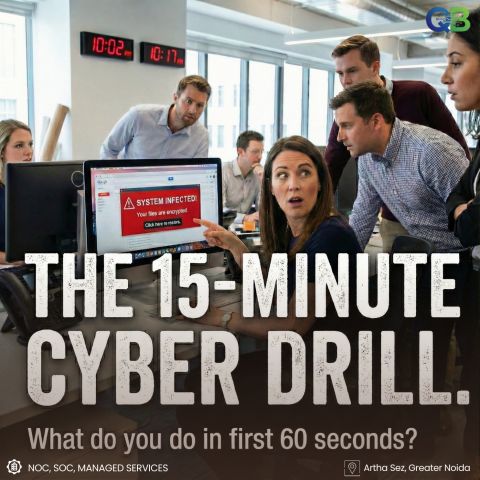
⏱️ The 15-Minute Cyber Drill That Builds Real Muscle Memory
Most companies train once a year.
Then wonder why people fail.
At Quisitive, we know:
Security isn’t learned in lectures.
It’s built in moments.
So run this lightning-fast drill — today.
Step 1: Pick a Scenario (One Per Person)
Read it aloud. Or send it in a chat.
No context. No clues.
Just ask:
💬 “What would you do in the first 60 seconds?”
🔥 10 Real-Life Scenarios That Reveal Hidden Gaps
Try one (or all):
- 📧 “Urgent: Click to renew your Microsoft license — expires today.”
- 💻 Screen freezes. Pop-up says: “Your system is infected!”
- 💬 CFO texts: “Approve this UPI transfer – I’m on a call.”
- 📱 WhatsApp: “Install this app to verify payroll access.”
- 📞 Call: “UIDAI. Give your fingerprint or your bank will be blocked.”
- ☁️ Alert: “Unknown device connected to company Google Drive.”
- 💌 Colleague sends: “Check our wedding card 👉 [bit.ly/invite-now]”
- 🏦 Vendor payment request — but bank details changed.
- 📄 PDF invoice opens → hidden script runs silently.
- 🚪 Employee copies 500 client files to USB during offboarding.
👉 Don’t grade. Just listen.
The goal isn’t perfection.
It’s awareness.
✅ Why This Works Better Than Annual Training
Most security training fails because:
- It’s boring
- It feels irrelevant
- No follow-up
But this?
- Takes less time than a Zoom meeting
- Sparks real conversation
- Reveals who’d click, forward, or freeze
At a BPO in Hyderabad, a 10-minute phishing drill led to 7 suspicious emails being reported the same day — including a live CEO fraud attempt.
That’s not luck.
That’s rehearsal.
🎯 What You’ll Discover in 15 Minutes
| Gap | What It Means |
|---|---|
| “I’d open the link to check” | Needs visual red-flag training |
| “I’d approve the transfer — he’s the CFO” | Requires dual verification culture |
| “I didn’t think it was risky” | Opportunity for micro-learning |
| “I’d delete it and move on” | Fear-based silence — fix with no-blame policy |
💡 Pro Tip: Reward the most cautious response.
Even if they’re wrong — praise the instinct.
Because doubt beats disaster every time.
🛠️ Make It a Habit: Weekly or Monthly
Don’t run this once.
Build a cyber reflex.
- Do it weekly — rotate roles
- Mix scenarios — keep it fresh
- Invite new hires on Day 1
- Share anonymous results: “Last month, 90% flagged fake invoices”
And if you have a NOC/SOC partner?
Ask them to share a real alert — stripped of names.
Then walk through:
“Here’s what happened.
Here’s how we responded.
Here’s what you should do.”
Real stories build trust.
💡 Prevention Isn’t Magic. It’s Rehearsal.
Hackers don’t attack systems first.
They study behavior.
They know:
- Finance teams approve transfers fast
- HR opens resumes without scanning
- Sales uses personal WhatsApp for work
But when you practice…
When you pause…
When you say “Wait — let me check”
You break their plan.
And you become the Human Firewall no malware can bypass.
❓ Has Your Team Ever Done a Cyber Drill?
👇 Yes / No — be honest.
If “No,” tag your IT lead, HR head, or operations manager.
Let’s make sure the next threat doesn’t win — just because no one practiced.
🔁 Share This With Your Manager
Safety isn’t built in code.
It’s built in habit.
Forward this to:
- Every department head
- New hire onboarding team
- Compliance officer
Because the best defense isn’t expensive tools.
It’s a team that knows:
🔐 “I may not be an expert — but I can pause.”
🔗 Learn More
👉 NOC-as-a-Service
👉 SOC-as-a-Service
Let’s protect not just data — but decisions.
#CyberSafeSeries #CyberDrill #SecurityAwareness #PhishingTest #NOC #SOC #QuisitiveSecure 🛡️📋⏱️


.png)
.png)
.png)
.png)
.png)