Q
U
I
S
I
T
I
V
E
Loading

Blog Detail
16
Jan
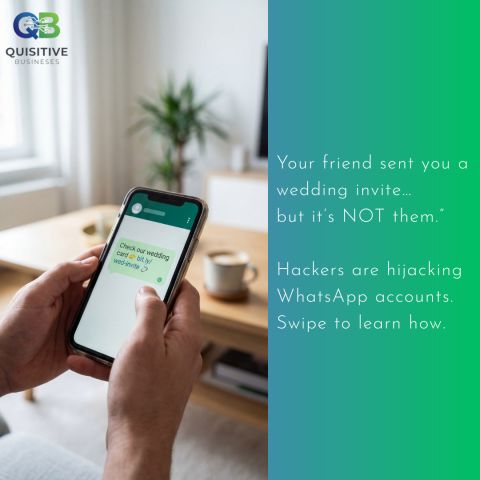
📱 New Scam Alert: That “Wedding Card” From Your Friend Just Stole ₹29 Lakh
“Hey! Check out our wedding card 🎉 [link]”
You get it from your college buddy.
Smiling couple. Cute message.
Looks real. Feels joyful.
But here’s what you don’t see:
👉 His WhatsApp was hacked last night.
👉 That link? Not a video.
👉 It’s a malicious APK file — disguised as joy.
One tap.
One click.
One "Install."
And in seconds:
- 🔍 They’re watching your screen live
- 💸 Opening UPI apps
- 📲 Transferring money — without needing OTP
- 🗑️ Deleting messages to cover their tracks
No malware alert.
No antivirus flag.
Just silence… and an empty bank account.
This isn’t fiction.
It’s happening right now in Bengaluru, Delhi, Pune, and Hyderabad.
With losses between ₹5 lakh and ₹30 lakh per victim.
And the worst part?
🔴 The hacker wasn’t a stranger.
🟢 It was someone you trusted.
🤯 How This WhatsApp Scam Actually Works
Hackers aren’t sending random spam anymore.
They’ve upgraded.
Here’s the new playbook:
Step 1: Hack One Phone
Usually via:
- SMS phishing ("Your Amazon order failed")
- Fake tech support call
- Malicious app installed earlier
Once they have access, they log into WhatsApp Web — and clone the chat list.
Step 2: Send Mass Messages to Contacts
Using the victim’s account, they send to all 400+ contacts:
“OMG is this you? 😳 [video link]”
“Check out our wedding card 🎉 [link]”
“You got ₹25,000 under PM Scheme – claim now!”
All links like this
"https://bit.ly/your-wedding-card-apk"
Leads to APK installation page
Which downloads an Android package (APK) — not a video or PDF.
Step 3: You Tap. You Install. You’re Hacked.
When you install the APK:
- It grants device admin rights
- Enables screen mirroring
- Lets hackers control your phone remotely — like TeamViewer for thieves
They open Paytm. Enter UPI PIN. Transfer funds.
All while you're sitting right there — unaware.
And since they never need your OTP?
🔐 Your 2FA is useless.
🔴 Red Flags You Can’t Afford to Ignore
❌ Message has a short link (bit.ly, tinyurl)
❌ Unexpected media from a friend
❌ Urgency: “Open now before it expires”
❌ Request to enable “Unknown Sources”
❌ Sender doesn’t reply when you ask: “Is this real?”
💡 Pro Tip: Always call back using a saved number — not the one in the message.
Because if they say “I didn’t send anything,” it’s already too late.
✅ How to Protect Yourself & Your Business
You can’t stop every attack.
But you can stop the damage.
For Individuals:
✔️ Never install apps from WhatsApp, SMS, or email links
✔️ Keep 'Unknown Sources' OFF → Settings > Security > Unknown Sources = ❌
✔️ Verify unusual messages with a voice call
✔️ Enable 2FA on WhatsApp → Settings > Account > Two-step Verification
✔️ Use Google Play Protect to scan sideloaded apps
For Businesses:
✔️ Deploy MDM (Mobile Device Management) for employee phones
✔️ Block installation of third-party apps via policy
✔️ Monitor endpoints for remote access tools (AnyDesk, Chrome Remote Desktop)
✔️ Train staff quarterly on social engineering red flags
✔️ Include personal devices in security awareness programs
At Quisitive, we monitor endpoint behavior across mobile devices linked to corporate email — detecting unauthorized screen sharing, suspicious UPI transactions, and abnormal data access — even if it starts from a “harmless” wedding invite.
🛡️ Why This Is Bigger Than One Scam
This isn’t about technology.
It’s about trust exploitation.
Attackers know:
- People trust friends more than banks
- Curiosity beats caution
- Joy disables suspicion
So they hijack emotions — then drain accounts.
And these scams are spreading faster than ever.
In Q3 2024 alone, CERT-In reported over 87,000 incidents involving WhatsApp-based APK attacks — up 300% YoY.
💬 Have You Received This Message?
Was it:
- A fake pregnancy video from a cousin?
- A “job offer letter” from a friend?
- A surprise prize claim from a colleague?
👇 Drop a 🚩 if yes — and tag your family group.
Because one share could save someone’s life savings.
🔁 Share this with your parents, employees, finance team, and HR head.
Security isn’t just IT’s job.
It’s everyone’s survival.
🔗 Learn More
👉 NOC-as-a-Service
👉 SOC-as-a-Service
Let’s protect not just systems — but people.
#CyberSafeSeries #WhatsAppScam #MobileSecurityIndia #APKHack #NoOTPScam #QuisitiveSecure #StaySafeOnline 📱🛡️💬


.png)
.png)
.png)
.png)
.png)