Q
U
I
S
I
T
I
V
E
Loading

Blog Detail
10
Feb
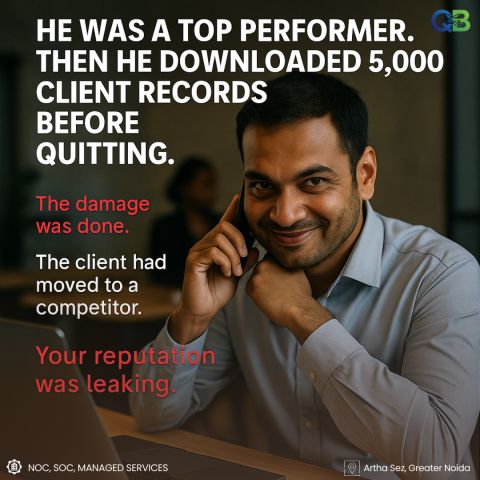
🛡️ “He Was a Top Performer. Then He Stole 5,000 Client Records Before Quitting.”
And no one noticed until it was too late.
No malware alert.
No firewall breach.
No hacker in a hoodie.
Just a trusted employee who used his access — legally — to copy:
- 🔹 Client lists
- 🔹 Pricing sheets
- 🔹 Contracts
- 💼 Everything he’d need at his new job…
👉 At your biggest competitor.
By the time leadership realized what happened?
📁 The data was gone.
💸 Clients had been poached.
🔐 Your reputation? Leaking fast.
And worst of all?
❌ His email was still active.
❌ CRM access never revoked.
❌ No alarm ever sounded.
This isn’t rare.
It’s happening more than ever.
And if you’re not watching, it could be happening right now in your company.
🔥 How an Insider Threat Actually Works
Most companies focus on stopping hackers.
But according to CERT-In and internal audits across Indian BPOs and fintech firms — insider threats are rising 3x faster than external attacks.
Here’s how it happens:
Step 1: Resignation & Notice Period
Employee resigns. Serves notice period.
Still has full access to:
- Salesforce / Zoho CRM
- Email & WhatsApp Business
- Cloud drives (Google Workspace, OneDrive)
Looks normal. Works normally. Smiles. Says goodbye.
Step 2: Silent Data Exfiltration
Over days or weeks, they:
- Export client databases
- Download contracts in bulk
- Print sensitive pricing models
- Forward emails to personal accounts
- Upload to USB or cloud storage
All activity looks “legitimate” — because it’s done using real credentials.
Step 3: Exit & Exploitation
They leave. Join a rival firm.
Start calling “their” clients.
Offer better rates — because they know yours.
And when you lose the deal?
You blame sales.
But the truth is darker.
🚨 Red Flags That Should’ve Raised Alarms
These aren’t theory. We’ve seen them in real cases.
| Warning Sign | What It Means |
|---|---|
| ✅ Mass file downloads at 2 AM | Preparing to exfiltrate |
| ✅ Printing 40+ pages of client list | Physical backup |
| ✅ Accessing HR records without reason | Fishing for contacts |
| ✅ Connecting unauthorized devices | Copying to USB drive |
| ✅ Logging in from unusual location | Covering digital trail |
The problem?
🔴 Most systems don’t flag this — unless you’re watching for it.
⚡ How NOC/SOC Stops Insider Threats Before Damage
At Quisitive, we don’t wait for complaints.
We watch behavior — so we catch danger before it walks out the door.
Here’s how we helped a top BPO stop an insider from transferring 8,000 mortgage files — just 17 minutes after suspicious activity began.
🔹 User Behavior Analytics (UEBA)
We build baselines of normal behavior:
- When do you log in?
- Which folders do you access?
- How much data do you download daily?
When someone suddenly copies 500 client records?
🚨 UEBA flags it instantly.
🔹 Automated Offboarding Alerts
As soon as HR marks “Resigned,” our system triggers:
- Access review
- Data export monitoring
- Immediate revocation plan
No delays. No gaps.
🔹 Real-Time Monitoring & Escalation
If an employee exports 10x their usual data volume? Our SOC gets an alert within seconds. Analysts investigate. Contain. Notify.
Before the file even finishes downloading.
🔹 Instant Device & Session Control
We can:
- Lock remote sessions
- Disable USB access
- Freeze cloud sync
- Isolate accounts — remotely
In under a minute.
📉 The Real Cost of Trusting Too Much
Let’s break down what one exit really costs:
| Loss | Impact |
|---|---|
| Client Churn | 15–30% of key clients lost within 90 days |
| Competitor Intelligence | Pricing, strategy, weaknesses exposed |
| Reputation Damage | Clients question your confidentiality |
| Legal Risk | Violations under DPDP Act |
| Internal Distrust | Teams start hiding data |
One person.
One decision.
Years of trust — gone.
✅ How to Protect Your Business
Don’t wait for betrayal.
Build protection.
For HR & Leadership:
✔️ Deactivate accounts on the same day they leave
✔️ Revoke access to CRM, email, cloud — immediately
✔️ Audit data access during notice period
✔️ Use NDAs + non-compete clauses wisely
For IT & Security:
✔️ Deploy UEBA + SIEM monitoring
✔️ Enable automated offboarding workflows
✔️ Monitor mass downloads, printing, USB usage
✔️ Integrate NOC/SOC for real-time alerts
At Quisitive, we help BPOs, healthcare providers, and finance firms protect their most valuable asset:
🔐 Not just data — but trust.
🔐 Bottom Line: Trust Is Essential. Verification Is Survival.
Your most dangerous threat might not come from outside.
It might walk into your office every morning.
Smile. Work hard. Earn bonuses.
Then leave with everything that made you successful.
And if your answer to:
❓ “Does your company deactivate accounts on the same day an employee leaves?”
Is “Not always…”
Then you’re already at risk.
❓ Be Honest: Yes or No?
👇 Drop a ✅ if yes — your offboarding is tight
👇 Drop a ❌ if no — and tag your HR/IT lead
🔁 Share this with anyone responsible for people, data, or growth.
Because in today’s world, loyalty doesn’t scale security.
Only visibility does.
🔗 Learn More
👉 NOC-as-a-Service
👉 SOC-as-a-Service
Let’s make sure the next departure doesn’t become a disaster.
#CyberSafeSeries #InsiderThreat #DataSecurity #BPOsecurity #EmployeeOffboarding #NOC #SOC #QuisitiveSecure 🛡️💼📁


.png)
.png)
.png)
.png)
.png)